
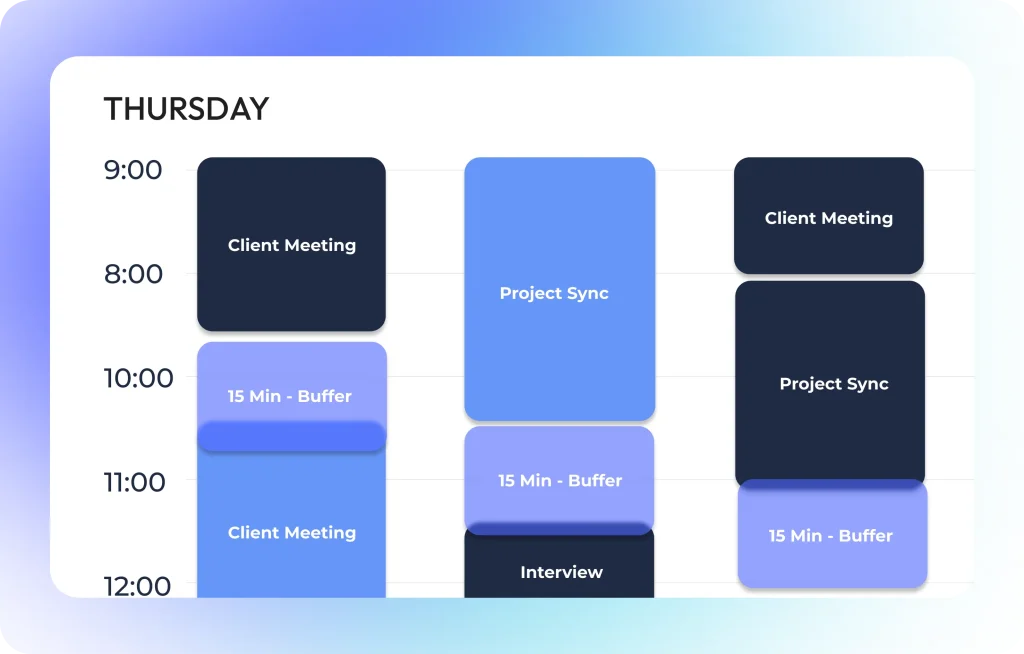
For service executives and agency leaders, time is the most valuable and non-renewable resource. In the race for productivity, a back-to-back schedule feels productive but actually leads to burnout, missed deadlines, and a rushed, unprofessional client experience.
The solution isn’t just saying “no” to meetings; it’s mastering the concept of buffer time.
This guide defines the strategic buffer time meaning and shares the best practices used by high-level executives to optimize their schedules and maintain operational efficiency.
What is Buffer Time? (The Strategic Definition)
Buffer time is a planned, mandatory block of unscheduled time inserted into the calendar—usually 15 to 30 minutes—between scheduled meetings, major tasks, or strategic blocks of focus work.
The Strategic Buffer Time Meaning:
Buffer time is not wasted time; it is operational padding designed to prevent three critical workflow breakdowns:
- The Overlap Problem: Prevents meetings from running over and making you late for the next engagement.
- The Context-Switching Tax: Provides the necessary mental space to close out the last meeting, process information, and mentally prepare for the next, reducing errors.
- The Follow-Up Gap: Ensures action items, emails, and immediate operational tasks are handled before they pile up.
Executive Buffer Time Best Practices (Case Studies)
Top service professionals don’t just use buffer time haphazardly; they integrate it into their daily operations with specific rules:
Practice 1: The “Bookend Buffer” (Context Switching Tax)
- The Rule: Always book a 15-minute buffer after any high-intensity meeting (e.g., client discovery calls, complex project reviews).
- Executive Case Study: A leading consultant at a B2B agency reported that the 15 minutes after a client meeting were dedicated to: 1) Capturing key notes and decisions immediately. 2) Converting the meeting outcome into the next step (e.g., sending the proposal, creating the project task). This practice slashed their “Time-to-Action” (TTA) from hours to minutes.
Practice 2: The “Focus Block Shield” (Deep Work Protection)
- The Rule: Book a 30-minute buffer before and after any planned 2-3 hour “Focus Block” or “Deep Work” session.
- Executive Case Study: CEOs often use this practice to “shield” their strategic time. The pre-buffer allows them to clear distractions (emails, quick calls) before the deep work starts. The post-buffer allows them to transition back to communication without immediately jumping into the next urgent request.
Practice 3: The “Client Polish Buffer” (Professional Presentation)
- The Rule: Mandate a 5-minute buffer before all external client meetings.
- Executive Case Study: The practice ensures the professional is never late and has time to review the client file, check technology, and be mentally present. This small buffer contributes directly to the Professional Polish brand attribute, reflecting well on the business and the service provided.
Practice 4: The “System-Mandated Buffer” (Automating Discipline)
- The Rule: Leverage technology to automatically enforce buffer time, removing the mental burden of managing it manually.
- LogicSuite Application: The platform is designed to automate this discipline. When you set up your Meetings or Bookings module, you can mandate a 15-minute buffer, ensuring no one can book a meeting back-to-back with your existing schedule. This ensures efficiency is baked into your operational system, not reliant on manual discipline.
Buffer Time and Operational Efficiency (ROI)
The strategic use of buffer time has a measurable return on investment (ROI) that goes beyond simple time management:
| Operational Metric | Benefit of Buffer Time | LogicSuite Connection |
| Revenue Protection | Reduces the chance of running late or missing a follow-up, which can lose a prospect or client. | Seamless booking experience with upfront payments prevents revenue leakage. |
| Team Coordination | Ensures team members have time to prepare for internal meetings, improving decision quality. | Smart scheduling scans team calendars, ensuring coordination is efficient. |
| Time-to-Action (TTA) | Provides immediate time to execute the action item from the preceding meeting. | Meetings are the gateway to project workflows (future ClickUp integration). |
Use Your Calendar to Protect Your Time
Fragmented scheduling tools often lack the power to enforce sophisticated scheduling practices like buffer time, leaving the discipline entirely up to you.
For top executives, protecting focus time is non-negotiable.
LogicSuite gives you the operational control to hard-code your buffer time and professional standards directly into your scheduling system.
By bridging coordination with intentional space, you transform your calendar from a reactive list of appointments into a strategic framework for high-performance work.
Protect your time. Drive strategic advantage.